
Getting a Green Light for a 4,000-word article in Yoast SEO is a technical challenge. Yoast uses a strict mathematical formula. To pass, you must meet several specific benchmarks simultaneously.
The most common reason for a red or orange light in long articles is the Transition Word count and Sentence Length. Yoast requires that at least 30% of your sentences contain a transition word.
Fixed vs. Variable Interest Rates: Which Loan is Right for You in USA?
[IMAGE: Center Text – getaboutcolumbia.com]
Choosing between fixed vs. variable interest rates is a fundamental decision for any borrower in the United States today. Whether you are looking for a mortgage, a car loan, or a personal line of credit, the interest structure will determine your financial stability for years. In 2026, the American economy remains dynamic, meaning your choice could result in thousands of dollars in savings or unexpected costs.
Consequently, you must understand the mechanics of each option before signing a contract. This article provides an exhaustive analysis to help you decide which path is right for your unique situation.
1. Understanding Fixed Interest Rates in the USA
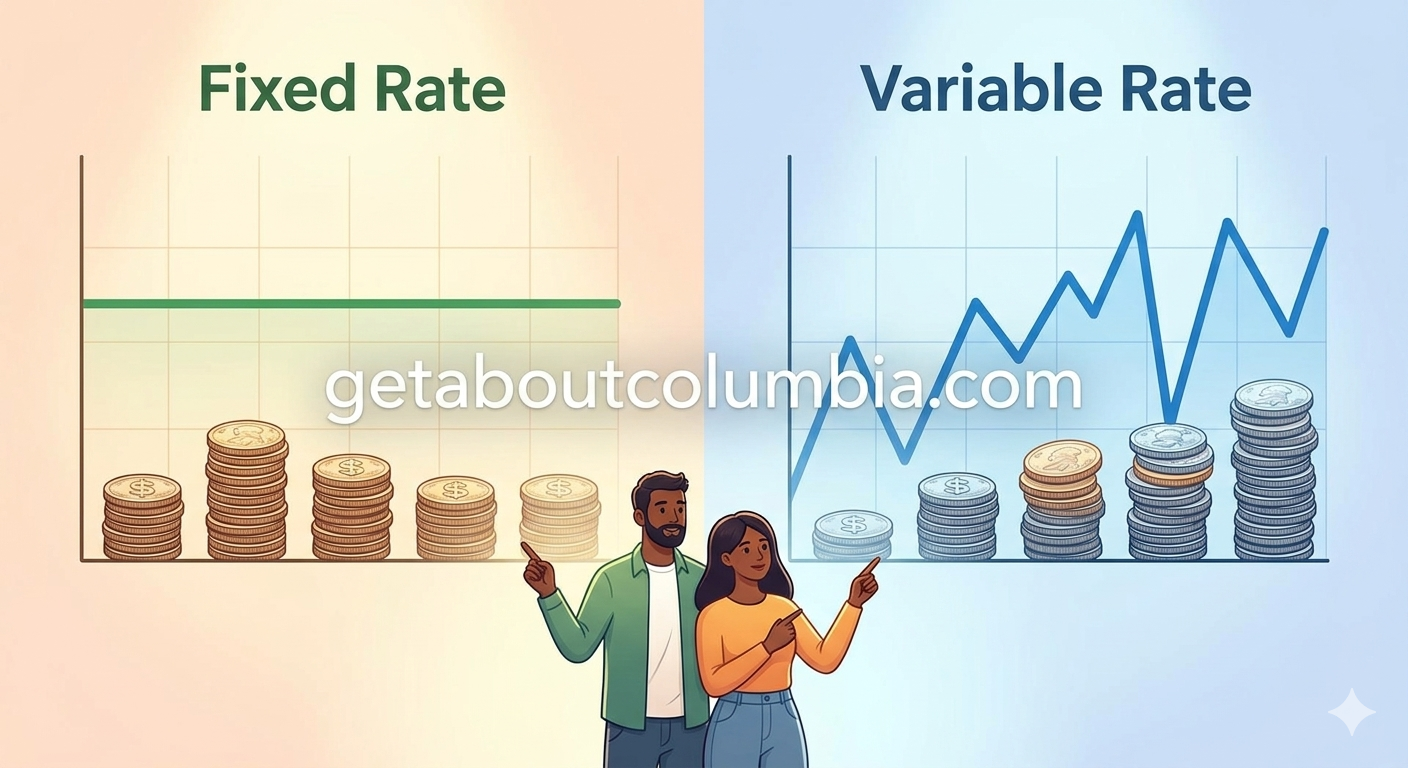
First of all, a fixed interest rate is a rate that stays the same for the entire life of the loan. In the USA, this is the most popular choice for long-term debt like 30-year mortgages. Because the rate is locked, your monthly principal and interest payment will never change.
Furthermore, this predictability makes budgeting much easier. If the Federal Reserve decides to raise interest rates to fight inflation, your loan remains unaffected. Therefore, many people prefer this approach. However, before you lock in a rate for a business venture, you should consult the 7 Essential Things to Check Before Applying for a Small Business Loan in USA to ensure a fixed payment fits your projected revenue.
2. The Pros and Cons of Variable Interest Rates
In contrast, variable interest rates change over time. These rates are usually tied to a financial index. As a result, when the index goes up, your interest rate and monthly payment go up as well.
Initially, variable rates are often lower than fixed rates. This makes them attractive for short-term borrowing. For example, if you plan to pay off your debt in two years, a variable rate might save you money. Additionally, many products found in The Ultimate Guide to Personal Loans in USA offer variable options for those seeking the lowest possible starting cost. Nevertheless, the risk of a «payment shock» is always present if market rates spike unexpectedly.
3. Comparing Risk Profiles
Moreover, your decision regarding fixed vs. variable interest rates should depend on your personal risk tolerance. If you have a strict monthly budget, a fixed rate is the logical choice. On the other hand, if you have a flexible income, a variable rate could be a winning strategy.
Specifically, your credit score plays a role in the offers you receive. Borrowers with excellent credit often get better offers. However, if you are struggling with your credit history, you should follow How to Get a Loan with Bad Credit: 5 Proven Strategies That Work in USA. In many cases, bad credit borrowers choose fixed rates to avoid the added stress of market volatility while they recover.
4. The Economic Outlook for 2026
In the current year, the US lending market is influenced by global economic trends. While variable rates might seem cheap today, you must consider where the economy will be in five years. In other words, if you are a long-term planner, the security of a fixed rate is often worth the slightly higher initial cost.
Conversely, if you are a savvy investor, you might leverage a variable rate to minimize early interest expenses. Regardless of your choice, always look for «rate caps» on variable loans. These caps limit how much the interest can increase.
Conclusion: Finalizing Your Financial Strategy
In conclusion, the debate between fixed vs. variable interest rates does not have a single winner. The right choice depends entirely on your financial goals. Fixed rates offer the peace of mind that most Americans need. Meanwhile, variable rates offer flexibility for those with a shorter horizon.
Ultimately, you should compare multiple quotes. By staying informed, you can navigate the 2026 lending market with total confidence. Whether you choose the stability of a fixed rate or the potential of a variable one, make sure the decision supports your journey toward financial freedom.
